Foam weights, or handheld weights or dumbbells may be used for improving upper body strength by resisting buoyancy. Dumbbells may vary in terms of buoyancy. A smaller circumference dumbbell or buoyant ring provides an easier level for strengthening upper body muscles during a water workout as compared to a greater circumference bell. New or less strong participants should be advised to perform the same mechanics or movement without any drag resistance prior to starting with foam weights. Adding too much overload of buoyancy equipment too soon may be harder to control than equipment that sinks so realize that foam weights are advanced equipment and the exerciser should have previous experience and skill prior to simply adding these to any program.
Dumbbells are often the most misused piece of equipment simply because the technique requires that the exerciser control their movements against buoyancy. All foam weight resistance work must be performed with a downward movement into the water or against buoyancy for resistance. Avoid in an dout of the water as well as simply keeping the dumbbell at the surface of the water and just moving fast on top of the water (this only uses momentum and will not provide any resistance yet joints may be compromised but more shearing of the shoulder.
Another consideration is that if a person has more body buoyancy (their body floats more than sinks) or does not have enough core and upper body strength they will have a challenging time controlling the upward movement or ascent. This often makes exercises difficult to control on the upward phase of the movement resulting in shoulders coming out of the water which will cause risk of injury due to shoulder impingement and excessive wear and tear on the shoulder -which overtime may result in shoulder problems.
Please note however, when dumbbells are instructed properly the dumbbell may add excellent variety and progressive overload especially for those participants who can work harder or require more core challenge and love more upper body strength challenge. Realize always that caution should be recommended for those individuals with shoulder and neck problems and those new to water fitness training.
Ideally, to progress exercise safely and progressively to build strength each individual needs to be cautious by not to do too much upper body strengthening their first session. Start with basic exercises like side to side rocks with pushing the dumbbells down and then progress into forward and side falls which test core strength and balance and are key to going to the next level. The technique for utilizing buoyant foam weight equipment and to optimize strength is to control the ascent of the movements to the top of the water. Do not to bring the equipment in and out of the water especially when arms are outstretched to the side (shoulder abduction) which is 100% impingement of the shoulders and further aggravated when the shoulders internally rotate which is often naturally done when participants have rounded shoulders or swim arms with more internal shoulder rotation. Rather, utilize the core and perform all upper body strength in neutral or suspended working positions to safely submerge and protect the neck and shoulders.
Less abled participants (such as people who have neuromuscular disorders or are new to the pool may feel more secure using buoyant dumbbells for support especially with basic walking patterns and to get them off the wall). This is essentially moving with a walker but may help initially to get the individual moving through the water for training function and mobility and to simply help them move comfortably in the water.
Pushing and controlling foam weights or dumbbells down into the water works! Pushing on top of the water does not work or has very little intensity and the momentum causes unnecessary shoulder wear and tear.
All foam equipment should be understood and exercise design should be properly executed. Many people casually pick up the largest buoyant dumbbell and start working with this prior to starting with the more controllable 5 inch circumference size (which is perfect for anyone who may have more body buoyancy).
In order to work safely and properly, check that the participant can get into athletic stance and have the arms outstretched (start position of latissimus dorsi pulldown) and they can keep shoulders completely submerged. If they cannot do this position properly, they should either choose a lighter piece of equipment (happy hand weight) or simply perform the exercise with their mitts only.
Buoyant equipment, especially when not controlled, will float upwards and pulls the body out of alignment and beyond the pain free range. The key for technique is to anchor the piece of equipment under the water. Push down into the water then resist and control the upwards movement.
When designing strength training the two “most” important things to consider are
#1 Progressive overload – gradually add exercises maybe one or two each class and train muscles to become stronger incrementally, and #2 Safety – assume that quality of exercise is more important. Slow down and control exercise and check that everyone is performing the exercise correctly and effectively! Side Fall with Lat Pull-down: Try a side fall with the dumbbells for an advanced the range of motion:. Lean into the movement and the lead or reaching arm pulls down and through the water. Be sure to initiate the action with the arm that is working and not the lower body standing up or Obliques with changing body positions. Remember to do both sides. Most people are dominant on one side so this is an excellent progression to balance strength from right to left sides. Ask participants if they are right or left handed and to check which side is easiest or stronger?
Test your Core with Triceps Dips in Athletic Stance
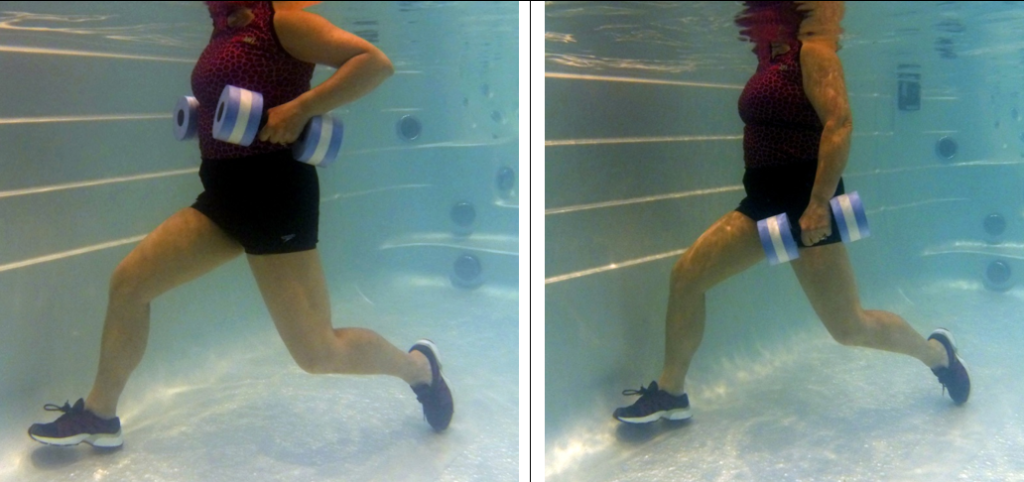
Start in Athletic Stance (which provides a wider base of support for balance than a squat position in water). Add the Triceps dips or press down with the dumbbells either unilateral, one dumbbell, or bilateral, two dumbbells. Be sure the shoulders are submerged and the body is in a neutral working position or water is at neck depth in athletic stance. This better trains the core abdominal muscles. Start with elbows bent to push down then control the ascent. When extending the elbows keeping the dumbbells close to the body and avoid locking the elbow (or jamming the joint). If possible keep the movement slightly behind the back. If a participant cannot stay submerged or in neutral working position (may be due to too much body fat or lack of core strength) then they should do another exercise. Try triceps dips and bicycling or triceps dips and flutter kick (these lower body movements will guarantee that the shoulders are submerged). Triceps dips and bicycle may be easier to perform and stay submerged. The instructor needs to monitor to make sure everyone is doing the exercise properly or safely. If anyone chooses to utilize too much resistance and the shoulders pop out of the water, verbally mention that the shoulders are only protected when they are submerged under the water and re-adjust for safety.