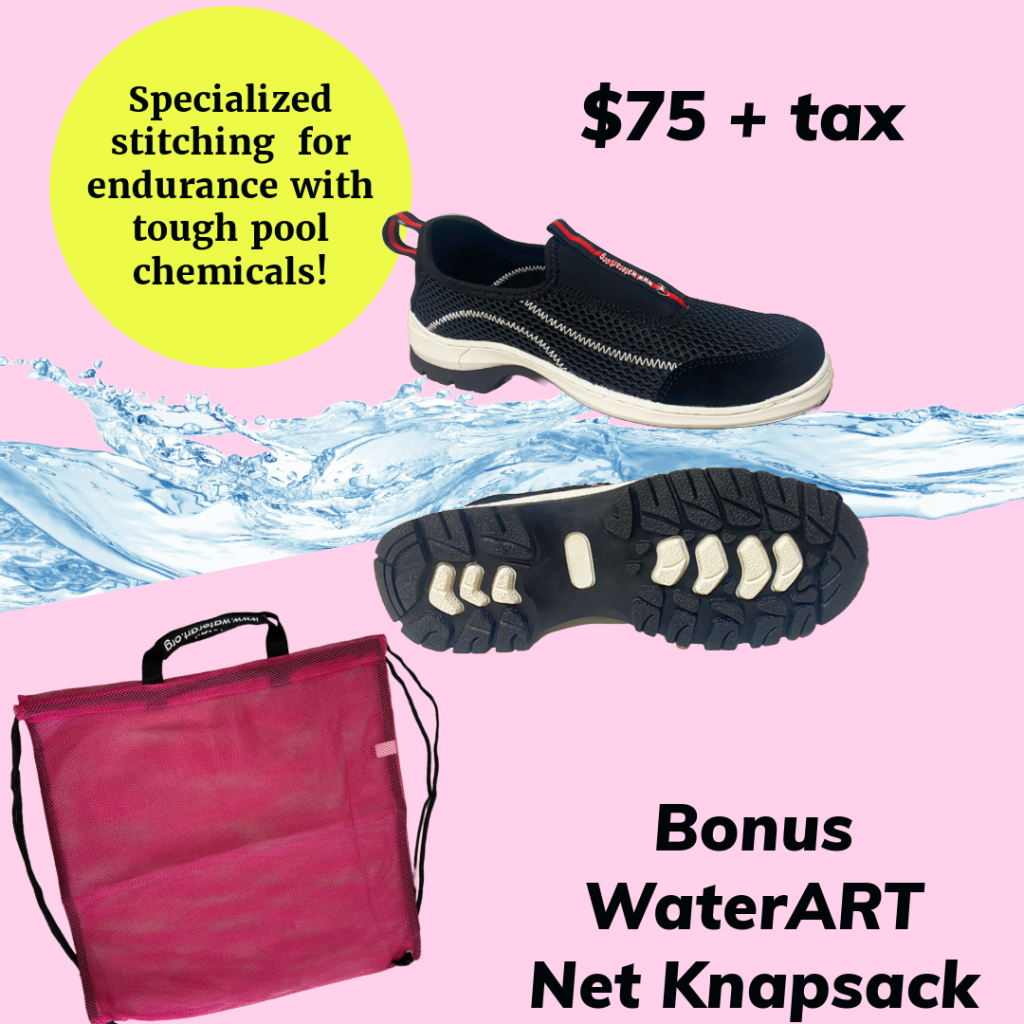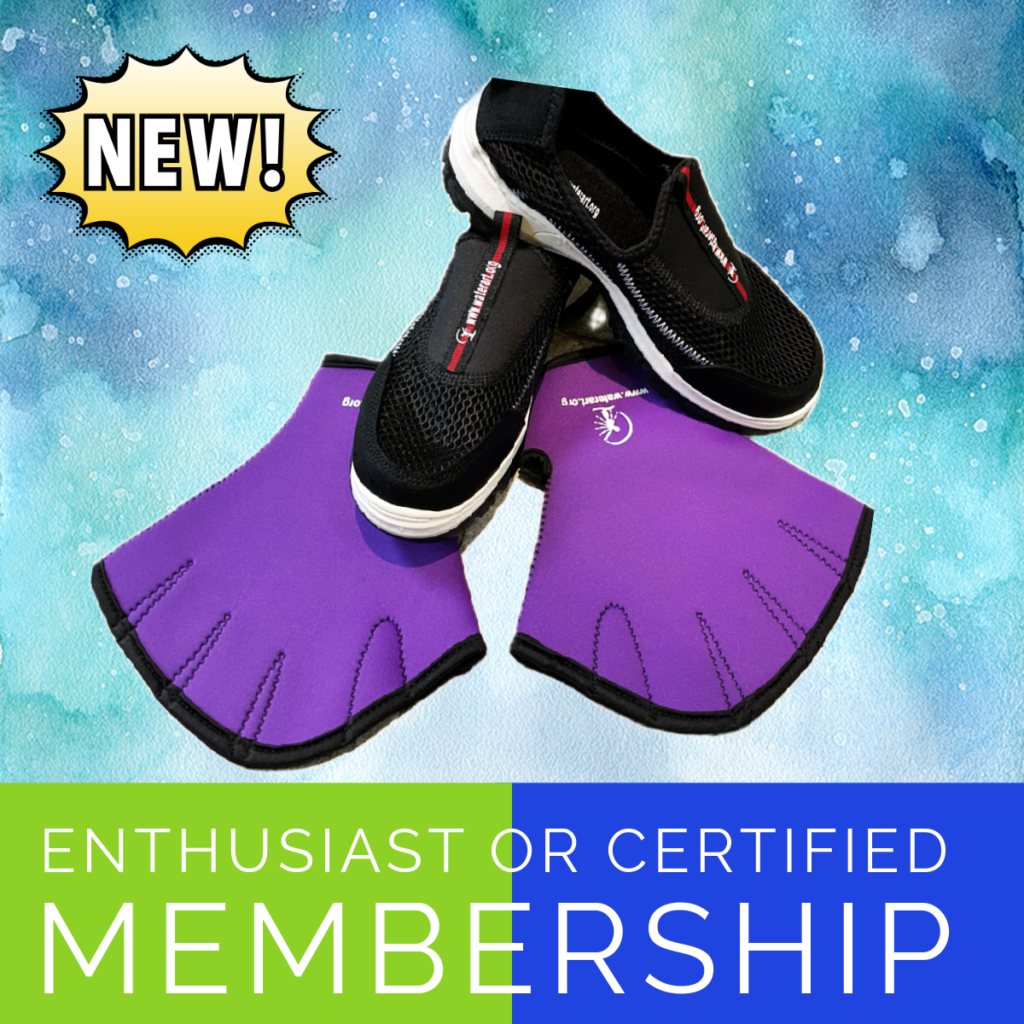
Why do we need to wear shoes in the water?
Unlike swimming, aquatic fitness is vertical exercise where resistive training helps participants become and remain sufficiently fit to enjoy their daily activities. Because of our generally vertical position, posture and good body alignment are the cornerstones of fitness. Shoes provide more stability and traction for an upright stance when moving through water. They provide protection by reducing impact when rebounding in shallow water. The shoe also creates a larger area of “push” and additional resistance in deep water.
How can we encourage wearing shoes? Talk it up or make a handout for your participants. Let’s examine a few reasons:
#1 Safety: Your first priority in any class is safety both in and out of the pool! Shoes help prevent accidental slips and falls on the deck and in the pool. How many of your participants are elderly? Imagine the serious consequence of falling and breaking a bone for an elderly participant! Even your younger participants can badly sprain a joint if they slip or fall.
Shoes are important for participants that need more stability. Stability and balance are inherently linked. The better balanced and more stable a person is, the more comfortable and happy they will be in your class.
#2 Protection for the feet. Shoes help prevent infection. Walking barefoot in a pool, pool area or dressing room creates the opportunity for picking up irritating conditions like Athlete’s Foot or Plantar Warts. These are often difficult to heal and can be painful.
The rough and smooth areas of a pool floor present the potential for injury as participants perform travel patterns and other mobility exercises. Shoes help protect them from stubbing their toes, scraping their heels, or even cutting their feet on a raised edge.
Diabetes is a common condition found in aquatic participants since many come to exercise in the comfort and relative privacy of water. They need to take special care of their feet and should follow the general rule that shoes are worn at all times to prevent injury.
Protecting the joints. Although water is a low-impact medium for an effective workout; there is always some impact which travels through the ankles, knees, hips, and low back with every rebound step. Those with joint issues often prefer working in a transitional depth to reduce impact on their joints. However, at this depth they may not be strong enough to push the extra volume of water and get a good workout. Instead, wearing shoes provides the option to move to shallower water. They can now work in a more beneficial depth providing added protection against impact.
#3 Help people get the best from their workout! Shoes can help increase traction which translates into increased speed. This translates into increased power. It follows that extra speed and power generate a higher intensity workout. Those focusing on weight management will get “more bang for their buck” because they will burn more calories. More advanced clients will be able to challenge their musculoskeletal and cardiovascular systems much more effectively.
What is the best depth for shoes? Both in shallow or deep-water, shoes will increase resistance on the lower limbs. They increase the surface area of the foot as it travels through the water resulting in increased drag on the legs, with greater muscle conditioning and cardiovascular results. In deep water, some shoes (such as Crocs) “float”. The user has to work to “anchor down” their feet against this buoyancy. The result is better core conditioning (abdominals and low back), and increased hip/leg strength.
What type of shoe is best?
On land, shoes are a must for successful workouts, whereas in the water, most individuals do not realize the same need to “dress for success”. When choosing an aqua shoe, cost is often a factor.
Technology and research has increased considerably over the past 20 years and specific aqua shoes are now available for both instructors and participants. There is a wide variety of shoes to choose from and the criterion must be: “How do you wish to use them”?
Instructors should wear a sports shoe if teaching on deck for protection against impact and slipping. These shoes must stand up to more wear and tear but, most importantly, be supportive to the foot and ankle. There are several makes of “aerobic” style shoes as well as athletic sandals that are specifically designed for this type of dual deck/water use.
The regular participant who stays in the water throughout the program should (minimally) wear an aquatic sock in the water. There are many more choices from the slip-on beach shoe through to “Crocs” or the instructor shoe previously mentioned. Once a participant has experienced wearing shoes for the water workout, their value as a fitness aid becomes obvious. It doesn’t take long before they upgrade to a better quality shoe.
How long should the shoe last?
A lot depends on their care. Air and pool temperature as well as the content (chlorine, saline etc) of the pool water can affect their life span. Of course the biggest factor is how often they are used during the week. Ideally they should be rinsed out each time after pool use, just as with bathing suits, mitts and other aquatic clothing. They should also be dried correctly – preferably in an open air space. Left in a locker or the trunk of a car, they will not dry out quickly enough and material rot or mould can set in.
Show professionalism! We are the leaders and role models for our participants. We need to be professional and safe ourselves. We need to wear shoes and encourage others to do the same. If we do not take care of our own bodies, how can we expect participants to listen as we offer advice on how they should take care of themselves?