DON'T LET YOUR KNEES STOP YOU FROM HAVING FUN!
EXERCISES THAT ARE A MUST FOR KNEE PROBLEMS
1. Recumbent Cycling
Initially unload the cycling movement and work on mobility of the knee. Start with a buoyancy belt and progress to a noodle bike. Focus on the circular action of the knee and both flex and extend the knees and hips. Start with normal range of motion and gradually increase the range of motion to the largest potential sizing. This exercise may be performed in shallow and deep depths, so, non-swimmers once comfortable with lifting the feet off the pool bottom, may cycle across the width of the pool.
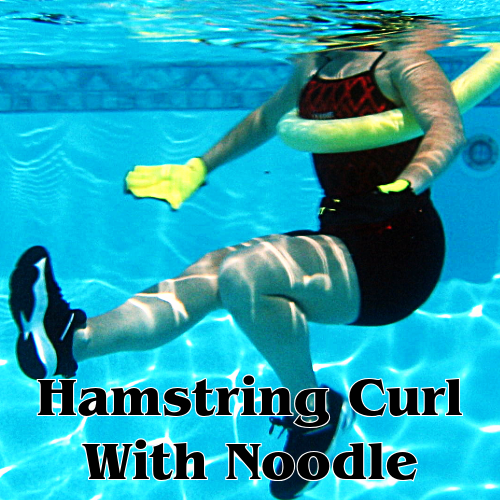
2. Progress to adding more balanced muscle strength using a single leg skateboard
Scull with the hands to maintain a good upright body alignment. Allow buoyancy to lift one leg forward and then pull the leg from in front to behind finishing with a bent knee. This exercise will yield or larger range of motion of the working leg which will also target the hip and ankle joints especially if the ankle dorsi flexes and plantar flexes (flex and point). The working or scooping leg is strengthening the hamstrings and gluteus maximus muscles which are key for knee strength. Most people are weak in the hamstrings which causes an imbalance for support with the knee. These people require more hamstring strength to prevent injury as well as knee pain. The supporting leg is working with the quadriceps and the gluteus maximus (as well as keeping the hip, knee and toe tracking) with the bend and extension of the knee. The ratio of strength for the agonist to antagonist (quadriceps to hamstrings) or strength ratio between knee flexors and extensors and their bilateral muscle strength deficit is 60 quadriceps to 40 hamstrings as mentioned above.
3. Walk backwards with a toe, ball, heel strike or articulation of the foot
Use both arms to assist travel and balance by pushing forward . Extend the hip so that there is a larger backwards step. Try to maintain a parallel alignment with the feet to optimize tracking of the hips, knees and ankles.
4. Walk sideways maintaining a parallel hip, knee and toe gait or parallel tracking is key for strengthening the hip abductors.
To progress the exercises slide the lead leg so that there is more resistance on the outward push.
5. Learn modified rebound
The easiest exercise may be a reverse lunge or modified rebound ski movement. Start with feet together and the arms sculling. Progress to an opposition arm and leg movement or as the right leg extends back the right arm moves forward. This down up down action will work the supporting leg quadriceps and gluteus maximus and the working leg ( leg extending back ) will work on hip mobility. Both are key for maintaining functional strength as well as to train balance for improving stride length and gait. This will help people to maintain their ability to walk and hold their own body weight which is key to moving independently.
6. Stretch the Hamstrings
The hamstrings are a two joint muscle (knee and hip). For for the most effective stretch plant one heel on the pool bottom and sit back with the supporting leg. Progress to walking backwards on the heels sticking the buttocks out to better stretch the hamstrings, low back (erector spinae), gastrocnemius and gluteus maximus. Be sure to keep knees soft but extended without locking the knees on both stretches.